 This information was featured in Creative Copy (CC), a Wisconsin Arts Board (WAB) e-newsletter that distributes information to artists and arts organizations. You can find more resources in WAB's online database. If you think we missed something, or if you have a question, reach out to WAB via email at artsboard@wisconsin.gov or phone at 608-266-0190. If you haven't already, make sure to join our email list to receive CC and other WAB resources!
If you are an artist/arts organization with creative aging programming, feel free to let us know so we can add it to this list. You can reach us via email at artsboard@wisconsin.gov or phone at 608-266-0190.
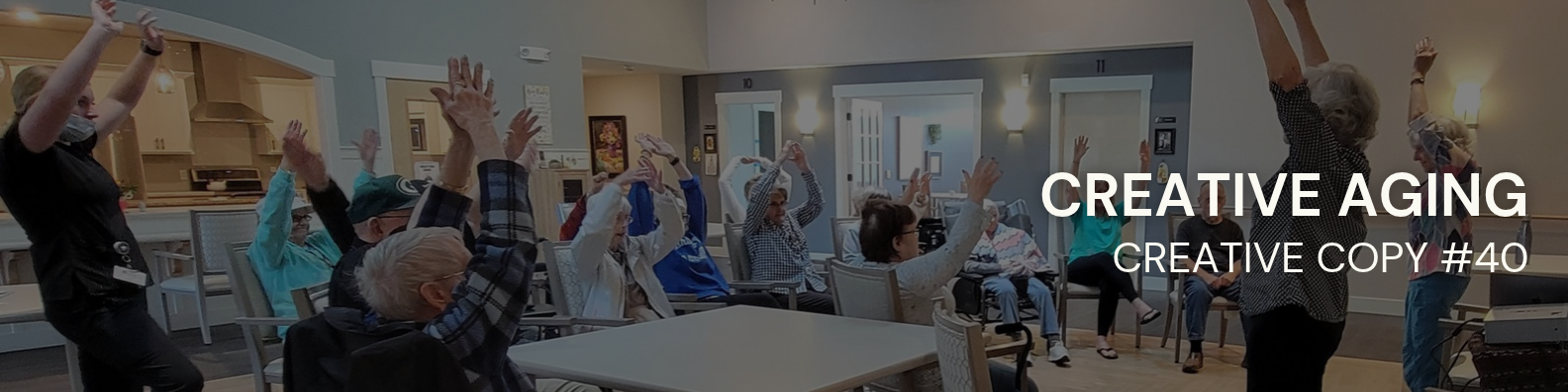
The photo displayed above, taken by Danielle Dresden, displays residents of Beehive Homes enjoying physical activity during FY25 Creation & Presentation grantee TNW Ensemble Theater's project, LET'S CONNECT. The LET'S CONNECT project involved interactive, hands-on programming for people living in memory care facilities and others from marginalized communities. TNW shared this story when reflecting on the project: "At one facility, a participant in our LET'S CONNECT project was actually working at the facility while she herself was recovering from a traumatic workplace injury. We saw her recently, several months after our work at this facility, and she told us that participating in our sessions had really helped her recovery. She said when she needs an extra boost, she still listens to the version of the song “When You’re Smiling” that we sang with the group. This helps her keep going as she rebuilds her strength and prepares to return to the job force."
What is Creative Aging?
Have you heard of the term "creative aging"? It was coined in a 2006 landmark study by Dr. Gene Cohen (The Creativity and Aging Study), which demonstrated the potential for arts-based learning to sustain the overall health and wellness of older adults. This study showed that older adults who engage with the arts experience better outcomes in physical health, mental health, and social connection and that people are neurologically wired to become more creative as they age (Creative Aging Innovation Forums Report: The Next Wave in Creative Aging). Especially as lifespans increase globally, and our Wisconsin population ages, there is a need for interventions that support the well-being of older adults living longer lives (Creative Aging Literature Review: The Role and Efficacy of Arts-Based Interventions in Older Adult Populations).
Creative aging has emerged as a powerful, evidence-backed approach to supporting health, well-being and lifelong learning for older adults. We've come a long way since 2006 (The Creativity and Aging Study), and numerous reports and peer-reviewed studies show that arts participation produces measurable improvements in physical health, mental well being, social connectedness and cognitive functioning among older adults. Programs are most effective when skill-based, sequential and led by trained teaching artists, and when supported by diverse funding models and cross-sector partnerships. Challenges include recruitment, accessibility and sustainability, but there are models offering replicable solutions. Creative aging is increasingly recognized as a core component of healthy aging policies in the US, with significant opportunities for state arts agencies and partners (NASAA: Vital & Vibrant Creative Aging Toolkit).
Learn more about Wisconsin's population and Creative Aging, and visit the resources below to help you and your community get involved in the practice. Bonus: two upcoming events (hybrid and in-person) for artists, educators, facilitators, and community members to explore creative aging.
Wisconsin's Aging Population
Wisconsin’s older adult population is large and growing. 26.6% of Wisconsinites are age 60+ and 19.6% are age 65+, with significant variation by health, income, and living arrangements. There are a few key issues that affect older adults in Wisconsin, namely:
Food Insecurity and Nutrition – 11.8% of seniors experience limited or uncertain access to adequate food (marginally food secure), 6.3% of seniors experience reduced quality, variety, or desirability of diet (very low food secure), and 1.5% of seniors experience reduced food intake (very low food secure). Around 30.9% of seniors eat less than 1 fruit a day.
Social Isolation – 27.9% of seniors live alone, and Wisconsin ranks 6th for risk of social isolation for ages 65+.
Poverty – 9.3% or 137,893 of seniors live below the poverty line according to the official poverty measure, and 8.0% or 123,357 seniors live below the poverty line according to the supplemental poverty measure.
Health Care Utilization and Costs – Over a quarter, or 25.2%, of seniors have a disability. 23.4% of seniors report "fair" to "poor" health, and 55% of Medicare participants age 65+ suffer from multiple (3 or more) chronic health conditions.
To learn more about Wisconsin's aging population, visit the Wisconsin Department of Health Services' Aging: Demographics in Wisconsin and Wisconsin's Aging Population: By The Numbers (Meals on Wheels). The Wisconsin Department of Health Services also supports the Bureau of Aging and Disability Resources and Aging: Programs and Services.
Creative Aging Resources
AARP Network of Age-Friendly States and Communities
The population of the United States is rapidly aging. In fact, by 2030, 1 out of every 5 people in the nation will be 65 or older. The common thread among the cities, towns, counties and states enrolled in the AARP Network of Age-Friendly States and Communities is the belief that communities should be livable for people of all ages. Learn how a town, city, county or state can enroll in the AARP Network of Age-Friendly States and Communities.
WHO Global Network for Age-friendly Cities and Communities
The World Health Organization Global Network for Age-friendly Cities and Communities was established in 2010 to connect cities, communities and organizations worldwide with the common vision of making their community a great place to grow old in. As a response to global population aging and rapid urbanization, it focuses on action at the local level that fosters the full participation of older people in community life and promotes healthy and active aging.
The Encore Years: Designing Impactful Arts Programs for Older Adults (Arts Midwest)
This guide, designed for arts leaders, aging-care specialists, community organizations, and arts-based programs, will explain what it is, why it matters, and how you can start a creative aging program in your community. Arts Midwest advances creativity across our region, building unprecedented opportunity for everyone who calls this place home. They support, inform, and celebrate arts organizations and creative communities in Illinois, Indiana, Iowa, Michigan, Minnesota, North Dakota, Ohio, South Dakota, Wisconsin, the Native Nations and communities that share this geography.
Creative Aging Resources (NASAA)
The National Assembly of State Arts Agencies’ Creative Aging resources includes:
Vital & Vibrant Creative Aging Toolkit – A comprehensive guide for state and jurisdictional arts agencies to make the case for creative aging, build partnerships, and launch programs.
Recommended Resources – Includes various reports and toolkits, like the Culture Track: Older Americans & the Arts, Creativity Matters: The Arts and Aging Toolkit, Lifetime Arts: The Creative Aging Resource, and communications guides.
Program Examples – Showcases state arts agency innovations and leading creative aging initiatives.
Research & Evaluation – Summaries of studies on the health, social, and cultural impacts of arts engagement for older adults.
NASAA is a nonprofit, nonpartisan organization dedicated to strengthening the nation’s 56 state and jurisdictional arts agencies.
The Creative Aging Resource (Lifetime Arts)
The Creative Aging Resource by Lifetime Arts allows you to access and share resources that highlight the benefits of arts education for older adults. Fueled by decades of research and 16 years of work in the field, Lifetime Arts is leading a national, multi-sector movement to establish creative aging as an essential driver of health and well-being.
TimeSlips
TimeSlips, founded over 25 years ago by MacArthur Fellow Anne Basting, is an internationally recognized nonprofit dedicated to redefining dementia care through creativity. The organization emphasizes imagination over memory, helping caregivers and care partners connect meaningfully with people experiencing cognitive decline. Its approach is evidence-based, award-winning, and person-centered, aiming to improve quality of life for both elders and caregivers while reducing stress and burnout.
Age-Friendly Greater Pittsburgh's mission is to bring generations together to reimagine how our neighborhoods are built, and to advance equity through advocacy, education and innovation. Their Age Inclusion Campaign, "Picture This,” showcases photographs, audio stories and media spotlights on the power of intergenerational connection in our communities.
2027 Opportunities for Artists, Educators, Facilitators, and Community Members to Explore Creative Aging (Dance Exchange)
Dance Exchange is a leading nonprofit performing arts organization expanding who gets to dance, where dance happens, what dance is about, and why it matters.
Dance On Winter Institute | January 15–17, 2027 | Takoma Park, Maryland
An immersive weekend for artists, educators, facilitators, and community members to explore creative aging, intergenerational creativity, and collaborative teaching through movement, dialogue, and shared artmaking. Sliding-scale tuition, limited scholarships, and work-exchange opportunities are available. Returning participants and former Dance On Cohort members are eligible for tuition discounts.
Dance On Cohort | January 19–June 22, 2027 | In Person + Online
A six-month learning community for artists, educators, and facilitators interested in deepening their teaching practice through creative aging. Cohort members learn alongside Dance Exchange artists and mentors, participate in shared learning gatherings, and gain hands-on teaching experience through a choice of in-person or online teaching tracks. The cohort includes registration for the Winter Institute, and sliding-scale tuition and limited scholarships are available.