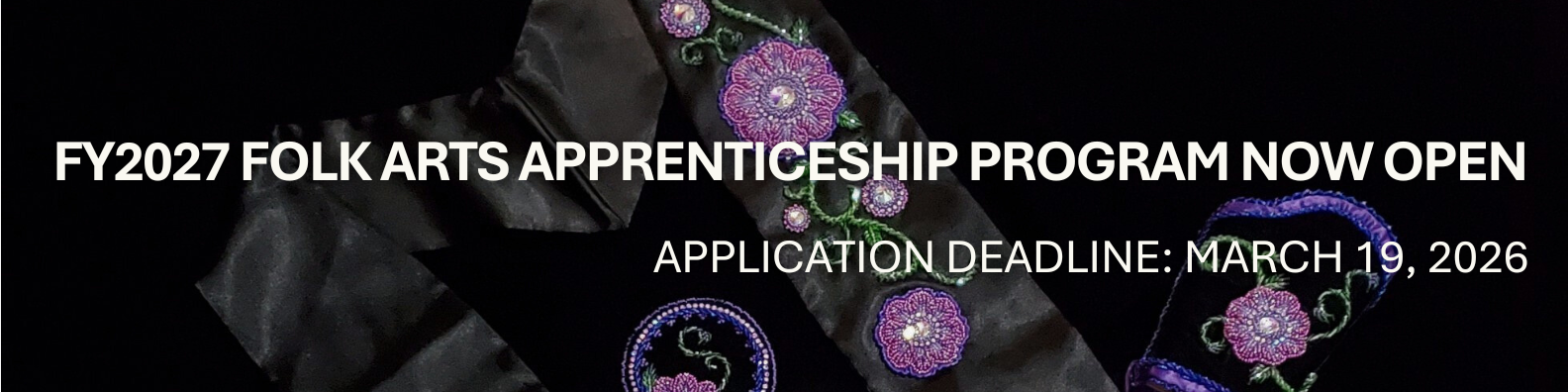
 Photo: FY26 Instructing Artist Eliza Skenandore’s Haudenosaunee raised beadwork.
We are pleased to announce the opening of applications for our Folk & Traditional Arts Apprenticeship Program!
What is it?
Folk & Traditional Arts Apprenticeships are designed to strengthen and encourage the continuity of Wisconsin's diverse cultural traditions by supporting exemplary traditional artists and culture bearers in passing their skills and knowledge on to committed and talented apprentices.
Any form of traditional art - from basketry to old time music, from beadwork to ethnic dance and singing, from instrument building to traditional foodways - as carried on by members of Wisconsin's various cultural groups, is eligible. These cultural groups are communities that emerge from shared ethnicity, language, religion, occupation, recreational pursuit, or geographic region. Priority will be given to instruction in art forms that are in danger of being lost or that help to preserve an endangered language. Both the instructing artist and apprentice should be committed to preserving and advancing the art form in their shared community.
Who can apply?
The Instructing Artist who will mentor the apprentice is the applicant. Apprenticeships must involve traditional art forms* that occur in a Wisconsin community* where they have value and a traditional place. See a list of past and current awardees for examples of such art forms.
Mentor/Instructing artists should be recognized as exemplary practitioners of their art form within their cultural community - held in high regard by their peers for their skill, knowledge, and community-based practice.
Prospective apprentices should have some experience in the proposed art or a related art form, display motivation to enhance their skills and cultural understanding of the art form, and care about it continuing in their community. Apprentices cannot be immediate family members under the age of 18. If the nature of the folk art allows, more than one apprentice may work with the same instructing artist at one time.
Returning applicants are not eligible to apply if they have received an apprenticeship award for three consecutive years; they may reapply after waiting one year.
First time applicants should have a conversation with Kaitlyn Berle, Folk Arts Specialist, (kaitlyn.berle@wisconsin.gov, 608-266-8106) to discuss eligibility prior to applying.
How much money can be awarded?
Maximum awards are $3,500 to the instructing artist or a fiscal receiver.* Successful applicants may use the apprenticeship award to help cover the costs of the instructing artist's fee, the supplies and materials needed during the apprenticeship, and in some cases, travel expenses.
When to apply?
March 5, 2026 (First time applicants only)
Notify the Arts Board of intent to apply. Notification can be in the form of an email (kaitlyn.berle@wisconsin.gov) or phone call (608-266-8106). Include a brief description of the intended apprenticeship.
March 19, 2026 (Application deadline)
Applicants must complete the Folk & Traditional Arts Apprenticeship application form and submit it by Thursday, March 19, 2026 to the Wisconsin Arts Board. If you are unable to complete an electronic form, please contact the Arts Board to make alternative arrangements.
How to apply?
Visit the Folk & Traditional Arts Apprenticeship Program page and familiarize yourself with the guidelines, information sessions, and other resources for applicants.
The Instructing Artist, as the applicant, will access the application by registering and then and logging into WAB's Online Application System. The application asks questions about the instructing artist, the apprentice artist(s), the art form, its connection to a cultural community, and the work plan. You will be asked about your ideas for a final public presentation of the work created during the apprenticeship, a requirement of the program. You will also be asked to provide a budget for how you will spend the $3,500.
Note: Applicants have the option to submit their responses to the narrative section of the application via video or audio recording. Please contact Kaitlyn Berle, Folk Arts Specialist, (kaitlyn.berle@wisconsin.gov) if you are interested in this submission method.
What is the apprenticeship process?
Awards will be distributed to the instructing artist in two payments: $2,500 at the start of the apprenticeship and the remaining amount after the public project has been completed and the final report has been accepted by WAB. All funds go to the Instructing Artist. For the current fiscal year (FY27), the apprenticeship and public presentation can occur between July 1, 2026 - May 31, 2027. The final report is due thirty days later, on June 30, 2027.
Do you have questions?
If you have questions regarding the Folk & Traditional Arts Apprenticeship Program, please contact Kaitlyn Berle, Folk Arts Specialist via email at kaitlyn.berle@wisconsin.gov, or phone at 608-266-8106.
If you have technical questions concerning our online application forms, please contact: Dale Johnson via email at
dale.johnson@wisconsin.gov or phone at 608/264‐8191.
Defined Terms:
*Community - Communities can be geographic places or groups with shared ethnicity, language, religion occupation, recreational pursuits, or regional affinities. Such groups share customs, heritage, and artistic expressions, which include the traditional arts.
*Fiscal receiver - An artist who works closely with a community agency may wish to have that agency serve as a fiscal receiver for the award. An incorporated, nonprofit, tax-exempt organization that provides administrative and financial services to the instructing artist for the apprenticeship is a fiscal receiver.
*Traditional arts - These are artistic practices that are transmitted and engaged as part of the cultural life of a group of people whose members share a common ethnicity, language, religion, occupation, recreational pursuit, or geographic region. Traditional art forms are often passed down from one generation to the next, or from one community member to another, and express a shared aesthetic, heritage, or tradition of a community. Such traditions will have endured through several generations with creative innovations by skilled practitioners throughout its history. The art form/tradition may have been revived after a cultural break due to the efforts of a committed artist.